
Quick tips to condense word count in your dissertation

A dissertation is usually around 80,000 words. As a research candidate, you strive hard to stick to the word limit in your dissertation, lest you get penalised.

Therefore, before beginning with your writing process, always create a rough framework of your dissertation and allocate a certain word limit to each of its respective sections. When you begin writing with a pre-decided word limit in your mind, you would focus more on the central idea of the research i.e. relevant aspects. You should ignore irrelevant facts and try making shorter sentences by making use of bullets.

Going a little above or below the prescribed word limit (10% of the whole text) is generally acceptable. But, what if you cannot manage to do so? Here are a few quick tips to reduce your word count after you have finished writing your dissertation

Describing Research Findings
Instead of describing your research findings in this way –

It was found that the mice in the research group A were less receptive to the medication as compared to group B. (22 words)

You can write a concise statement in the following way –
The mice in the research group A were less receptive to the medication as compared to group B. (18 words)

Delete adverbs
Spot all adverbs i.e. all words in your text ending with a – ly and replace them with a single more word to decrease the word limit. For example –  


Richard ran quickly towards the door to open it. (9 words)

Richard hurried towards the door to open it. (8 words)


Remove Verbosity & Redundancies –  Prune the sentences and remove all words which induce wordiness in the text. For example –

The actor with versatility, ……………………

The versatile actor, ………………………….

Here replacing the noun versatility with the adjective versatile cuts out the wordiness.

Also, remove redundant elements from the text like in the following example –

Mark was extremely irate, displeased and annoyed. (7 words)

Mark was annoyed. (3 words)

The above three adjectives are synonymous and therefore, using them all in the same sentence hardly provide any added value to the sentence.

Contract Compound Verbs – Contract compound words in the following way to reduce the word count by half –

Have not – haven’t
Does not – doesn’t
Will not – won’t
Could not – couldn’t
Should not – shouldn’t

Remove Prepositions – Removing prepositions can provide lucidity to your content. For example –

Tea from Turkey – Turkish Tea

Writer of detective fiction – Detective Fiction Writer

Make Judicious Use of Tables & Figures
Tables and figures are exempted from the word count. Therefore, try to place your data in a tabular form instead of lengthy paragraphs.

Prefer Active Voice Over Passive Voice
Active voice simplifies the sentences and improves readability. For example –

The letter was taken by Gillian and was delivered to the manager immediately. (13 words)

Gillian took the letter and delivered it to the manager immediately. (11 words)

Hyphenated words
The easiest way to deceive the automated word processing systems is by making use of hyphenated words. As these words are counted as one even though they occupy the same space. Few examples are –  half-serious, half-hearted, cross-complaint, bail-out, build-up etc.

Although, these are minor alterations, self – editing can reduce the word count to a certain extent, if done extensively. Yet, for substantive editing, it is advised to take help of a professional academic editor  as they can effortlessly maintain brevity in the text without compromising on the quality.
A Quick Guide to Hypothesis Testing in Statistics

This article provides a beginner’s guide to master hypothesis testing in statistics. An example is provided to explain how the guide works.

Hypothesis testing is an important factor for predictive modelling in the field of statistics. Hypothesis testing consists of the following important concepts:

  • Z-value (Z), a statistical term, which is the measure of the standard deviation from the mean value, resulting in the computation of the observed value.
  • P-value, another statistical term associated with the standard normal distribution.
  • Z-table, which shows each P-value associated with each Z-value.
  • Central limit theorem, which is an important theorem in statistics. This theorem states that the mean distribution of the sample size must be normal irrespective of the distribution of the population.
  • Significance level, also called as the alpha level, denotes the accepted cut-off level. In general, a significance level of 5% is acceptable in statistical terms. If the computed probability is lesser than the significance level, it can be concluded that there is no difference between the sample population and the total population size.

Example

For obese patients, the blood-glucose levels are at a mean ( ) of 100 with a standard deviation ( ) of 15. Research has suggested that diet rich in raw corn-starch can raise the glucose levels. A sample size ( ) of 36 patients who were tried with this diet did have an improved glucose level of 108 ( ). Perform a hypothesis test on whether raw corn-starch is beneficial.

Guide to performing hypothesis testing

  1. Determine the type of hypothesis testing (Null or Alternate). For this example, let us choose Null hypothesis.
  2. State the hypothesis for the above example. The population mean is 100.
  3. Set up the significance level. As it is not mentioned for this example, assume it to be 5% (or 0.05).
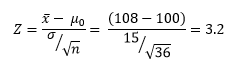
  4. Calculate the random chance probability, using the following formula:

formulaThe P-value associated with the Z-value of 3.2 is 0.9993. This means that the probability of having a value less than 108 is 0.9993, while the probability of having a value equal to (or more than) 108 is (1-0.9993), which is equal to 0.0007.

  1. As the computed value of 0.0007 is less than the significance level of 0.05, the Null hypothesis test to determine the raw corn-starch effect can be rejected.

Reference
Vidhya, A. (n.d.). Your Guide to Master Hypothesis Testing in Statistics. Retrieved from https://www.analyticsvidhya.com: https://www.analyticsvidhya.com/blog/2015/09/hypothesis-testing-explained/

Is it Possible to Avert Accidental Plagiarism by Students?

Plagiarism, lately has become a very common problem at college level and all students at university level need to be aware and at the same time cautious of it as it can have severe consequences if one isn’t careful or proactive. Often it so happens that researchers or amateur writers indulge in plagiarism out if sheer ignorance and not any deliberate attempt. This may so happen when they aren’t aware of the rules and regulations appropriately. One should not take plagiarism as an unsurmountable challenge, it is possible to overcome or stay away from the concern of plagiarism if novice researchers are careful and cautious of few things while doing research:

For researchers and writers who are at the nascent stage, their work can be compared on the basis of the level or originality that the writer presents. A good writer takes ideas and arguments from existing literature and cites them appropriately weaving their own concept around it where as a poor writer would just simply present an existing concept as his own novel idea.
These few tips can help you to avoid plagiarism for new writers:

  • Do not ever use passages, words, quotations or ideas that already exist and present them as one’s own ideas. It is important to cite every existing idea whether it be written or any other multimedia form.
  • Using the cut and paste method is MS word is very luring and exciting, especially when one is in a rush and wants tom meet a quick deadline. One must never cut and paste the content from any online source but always adopt the method of paraphrasing any idea you intent to use in your research.
  • It isn’t a good idea to duplicate your own work from one document to another as your previous work does not become original for any current work you undertake. Ironical but plagiarism is also applicable on re using your own previous idea without citing them so your become the thief of your own intellectual property.
  • You must undertake group work only in an authorised setting. Often professors do not appreciate researchers work in groups unless it isn’t an assignment. The best kind of learning happens as an individual assignment, so be wary of working on any group assignment in an unauthorized setting.

So be very particular while writing research to never do write any content from another source without adding the citation as little negligence from your side can actually have consequences that would make you repent your act.

How Does a Dissertation Outline Help?

Firstly, let us understand what is a dissertation outlines so that if you are one of those who is writing a dissertation and does not have one yet, you wait no more and create it as the first thing after reading this blog.
A dissertation outline is a list that is a summary of the content and the activities that are required for producing a good dissertation. Ideally, it is to be prepared at the beginning of the dissertation after the topic is chosen. There are various advantages of having an outline and make it an integral part of the dissertation. Here are some benefits not to be missed:
•It aids the scholar to organise his work
•A dissertation outline helps the student to plan the work in an efficient maner. Meticulous and detailed planning always helps in preventing the last minute rushes that can cause mistakes to occur.
•It is nothing less than a guiding tool that can help the student to execute the writing process effectively
•It gives a good and planned structure to the dissertation and helps to improve the final appearance of the dissertation
•A good dissertation outline is something by which the scholar is able to assign adequate time to each part of the essay
•The review of the work also becomes easier and simpler because of a well drafted outline as it can be reviewed against some previously drafted standards
•It enhances the appearance of the document and makes it simple and neat which further helps in simplifying the proofreading exercise.
•Time management and allocation becomes easier and the scholar is able to decide how much needs to be allocated to each section
•An outline is way to chart out the scope of the document and determine the width and depth of the document so that one can know the amount of time and effort needed for the document.

Do you need more reasons to get convinced for creating a dissertation outline? If you are convinced here are some characteristic of a good outline:
•It should be well organised
•It should be well prepared and neat
•It should be simple , detailed and straightforward at the same time
•It should be objective, focused and straightforward
•It should be comprehensive and have no extra information about other subjects

Thus, don’t wait any further and using reliable sources, do meticulous planning and creatively draft your outline so simplify your dissertation writing journey.

A lot of writing advice may be just futile for scholars. Why?

PhD students have a huge amount of writing advice available to them. There are large number of books, blogs and articles that are going around and increasing in numbers to extend advice to PhD writers so that they can handle it easily. However most of that advice is similar and does not come to much help to the writer.

Some of the most commonly found tips are:
1.You must write every day, from the beginning of your PhD
2.Do not think too much while writing as this may obstruct the flow of ideas
3.It is better to have the work done rather than have perfect work
4.Rewriting is an integral part of writing and need not be taken as a separate pressure or load.

Most of these tips are known by all they should work for all but despite knowing them a lot of scholars are found badly stressed with the writing process. This is because advice that is common to all may not necessarily be sufficient for all.

All those people who usually give writing advice are writers themselves and mostly they would be applying those tips in their own lives. But writing is not a straight path. It is a process of immense complexity and narrowing it down a single statement advice is actual oversimplification of the complexity of the process.
The reason I think these tips do not work is that you need to incorporate a skill to apply those tips in a customised manner for your own benefit. You need to leave the simplification of the advice and the subtlety behind to be able to make it useful for you.

When you read advice from various corners, you may find a lot of theoretical models that bring skill development but it is your expertise end of the day that will determine the amount of effort you have taken. When you are an amateur, there is a lot of concentration wanted in each element of writing, but to a seasoned writer, most of the things come without any conscious effort.

This principle is not just applicable in sports coaching, but it flows equally well in creative activities also that to come in the flow of doing things effortlessly, you must have high level of expertise. However, you being good at something doesn’t necessarily makes you a good advisor too. It is ultimately the writer who has to polish and surface out those skills to be able to adopt and adhere to the tips given by the advisors.