Editing is inevitable for a Thesis. Why?

Editing remains indispensable for any kind of research document or report. If you are editing is perfect, and immaculate it surely helps you to stay ahead. When a report is edited well, it assists the reader to understand the content, and other information in a simple manner. Once a second set of eyes scan through a document with a fresh perspective, it enhances the quality of the document. A worthy, and genuine editor always tries to go in the depth of the content and does not just look at his own monetary gains. They have the knack to identify grammatical errors in just a glance, and can suggest ways to enhance the simplicity and clarity of a sentence by just rephrasing it. A researcher should evaluate his report critically and at the same time, assess the skills and efficiency of the editor before allowing him to edit his most crucial document. A second set of eyes is mandatory and required to ensure that the thesis is closest possible to perfection.

A successful writer has to have backing of the good editor. Publishers always hesitate from investing in content that is not edited well. Even those who are writers in areas such as fiction or other categories always seek the help of proficient editors, who can add glamour to their writing. It is after all about the presentation of the work. Editing is also of different types, such as, substantive editing, copy editing, and proof reading. The quality of your work would determine the kind of editing needed by you. You must choose the type of editing, and the editor according to your subjective requirement. In the first interaction that you do with the editor, you should be able to clearly tell him the expectations you have. Ensure that there is no ambiguity and complete clarity is there about the kind of output that is required by you. You must specify the time frame also very clearly and realistically. If you are going to be hard pressed on the time span you give to the editor, it would impact the quality of the work so make sure that you keep that in mind and decide all aspects, monetary and non-monetary on the grounds of the level of output you are expecting.

So, be very clear that the more well written your content is, larger is the need to bring it closer to excellence by giving it in the hands of an excellent editor.
If you ever have to be an Interviewer: you should be like…..?

A good interviewer is a person, who has to be multi-faceted. He is a “jack of all trades” because his role is very complex and challenging.

If you are researcher, there is a strong chance that you would get that opportunity to be an interviewer, once at least, because it is an integral technique of data collection. It surely requires some homework and preparation from your side before you venture into the field with the cap of an interviewer:

List down the cooperation and involvement you expect from your respondents: You have to identify your respondents, with their availability and schedule. You must know who will be the best people to interview, according to what kind of expectations you have from them, and what is your objective of the research.

Ways to motivate respondents to perform well: As an interviewer, first of all, you go to take the work seriously so that your respondent also absorbs and depict seriousness of similar intensity in their work. Remember, only when you are convinced about the importance of your research, that you can convince others.

Have clarifications ready for all concerns: You should be prompt enough to handle all questions that come up from respondents, instantly. You can be prepared for some questions and some may come to you unanticipated. Your candid, spontaneous and prompt response is sought here.

Have parameters ready to assess quality: While you are in the process of interviewing, not all respondents would be authentic and genuine, in the same degree. Some may give you casual answers and others may be more focused. Ignoring casual and non-serious responses is imperative for the quality outcome of a research. While in the process of interviewing, the interviewer must be ready, and smart enough to assess the quality of the responses, either through the body language or seriousness in responses given by the respondent.

Bring consistency for quality: Doing interviews is not a one day process, and requires consistency in effort and motivation throughout the endeavour, despite challenges of poor, uninterested respondents and other distractions that may come in the way throughout the process in terms of time, money and quality of responses.

Is taking a break from academics before you start your Ph.D. a waste of time?

Results are best when we do a task in one go. The same rule applies to academics as well, generally and according to common sense, at least this is what most people believe. However, there is always a lot that swims against the tide, always and everywhere. You may find a lot of students who desire to take a break between their post graduate degree and their doctoral studies and most of them never seem to regret it. Well, it has some advantages. Let’s look at some:

Explore new avenues: Monotony does kill the scope to know more and find out other things we may like equally or even better. When you stop by to explore what else the world has to offer to you, you may get pleasantly surprised by getting exposed to a new flavor of life you perhaps never knew that existed. Only having done wonderfully in graduation or post graduation academically should never become the sole reason for you to take up higher studies. Sometimes, taking a break and being away from the routine can help you to discover new likes and preferences which could be suppressed all the while under a mundane routine and it might end up becoming a passion for something you never had any clue about prior to trying.

Pick up professional skills: Until you essentially move out in the field, you may never learn skills needed in practical life.When you decide to take a break from academics and work professionally for a bit, you would get a chance to aplly all theories into practice. It would provide you the confidence of earning as well as knowing your strengths and weaknesses.

You get an option to choose if you don’t want to go back: as we grow and learn more about ourselves our likes, dislikes and preferences alter and modify, and we may surprise ourselves by not finding our passion in something we have been thinking all the while. Having another option in hand is always more confidence boosting

So, if you are confused about whether to give in the temptation to take a break before joining a Ph.D., go ahead!! Remember, well thought decisions are the best.

Do you know the facts and rules related to the use of ITALICS?

We often see writers using italics in their writing, as and when they wish to. Sometimes writers use italics to highlight some content they wish to like a quotation or a proverb. In fact, most of the times, at their free will, we see writers using italics to highlight, beautify or showcase their content. There are some facts in English language that are related to the use of italics. If you haven’t heard of them before, don’t forget to do so now and note then down for all your further writing attempts.

  1. Italics can be used when you are incorporating few words from a foreign language in your content.
  2. Italics has to be used to write algebraic expressions. For instance, when you are writing the value of “x” in any formula, so “x” has to be in italics.
  3. Like I said before, italics is used by writers for the purpose of emphasis on a specific word, however it should not be done in the case of formal, especially academic writing.
  4. In some places, if you feel the dire need to emphasise on a specific word and you feel the content would be incomplete without it. It is a good idea to mention in brackets, just next to the word that the purpose of italics is to emphasise on the word.
  5. Most of the styling guidelines such as APA & Chicago Manual of Style have their own specifications about the use of italics and according to the guidelines, most of the Latin words are not italicised.

As a researcher you must be careful of not overusing italics as it may create a negative impact about your research rather than solving the purpose you had in your mind. In a state of complete ignorance, often writers try to beautify their document by using italics liberally but it goes against the norms of formal academic writing often supervisors feel put off with over use of italics. The writing shouldn’t be just simple and easy in terms of content but also simple and as much as possible uncomplicated in terms of font and formatting. When you do that, you send a message to your reader that your content is strong enough to not need the support of complexity in language or display. It is sufficient in its strength to engage you as a reader.

How to Make SPSS Produce APA Formatted Tables Automatically

Do you want to know how to save 90% of your time on formatting the SPSS tables?
Well, it’s quite simple.
All you have to do is to make minor modifications to the SPSS settings and you’re done. Yes, it is that simple.
As you know the conversion from SPSS to Microsoft word format is frustrated and tedious but the pain can be reduced if your entire manuscript contains tables which is of course not possible.
fig1

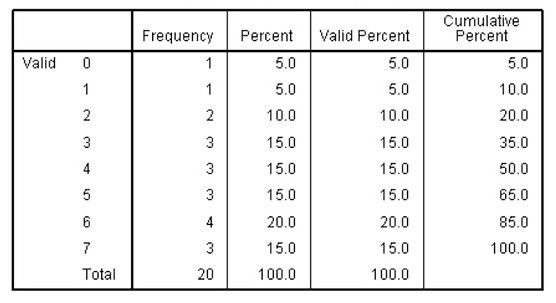
Fig 1: SPSS Default Table

fig2

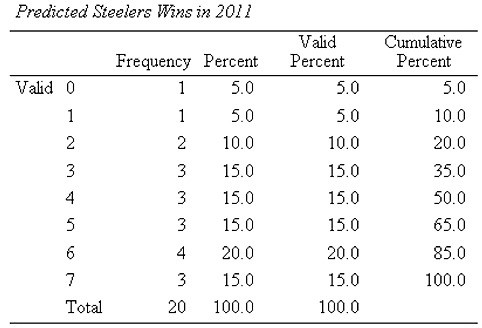
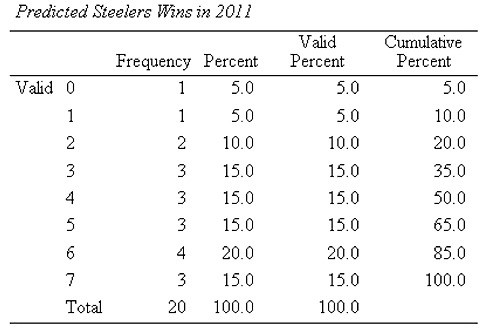
Fig 2: APA formatted Table
Let’s see how you can save your time and create a perfectly APA formatted table.

    1. Create the variable and Input data:

The first step in making the adjustment to the SPSS involves creating the variable and inputting the data.
For creating the variable:

      • Open the SPSS statistics data editor.
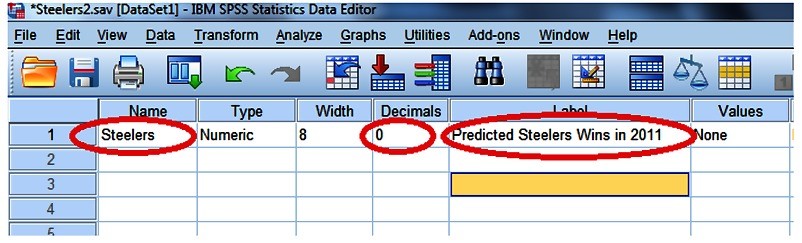
      • Create a new variable under the variable view and do the following:
        • Give a name to the variable.
        • Set decimal to zero
        • Give a label to the variable.

        fig3

      • Enter the values for the variable in the ‘Data View’ tab.
  1. Creating a custom table for editing:
    The second step involves producing an initial table for editing.

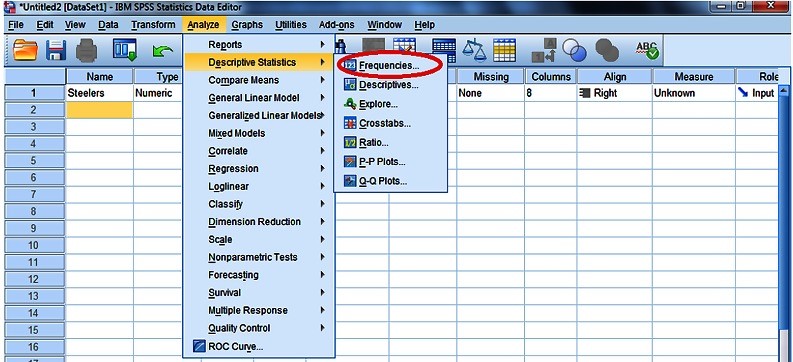
    • Go to ‘Analyze’> ‘Descriptives’ > ‘frequencies’
      fig4
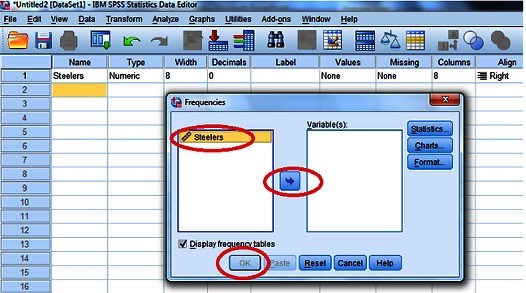
    • Drag the variable to the ‘Variable’ column and hit ‘OK’
      fig5
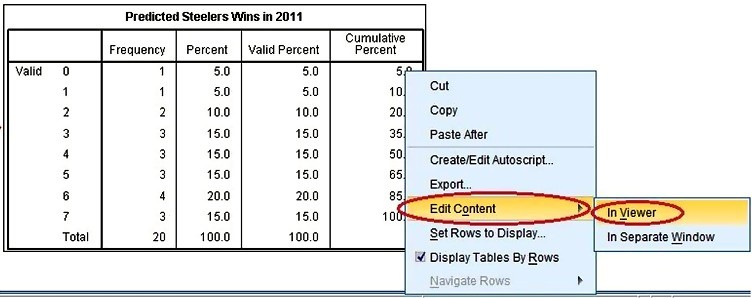
    • Go to the ‘label’ and perform right-click, select ‘Edit Content’ > ‘ In Viewer’fig6
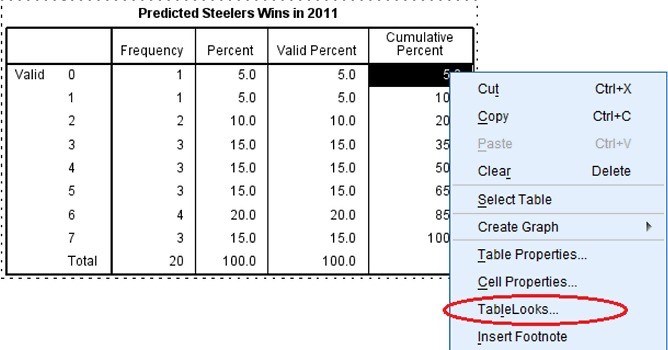
    • Again perform right-click on the table and select ‘TableLooks’ (It’s a template that tells how SPSS format data table )

    fig7

  2. Create a new ‘TableLook’ fig8
    For creating a new Table Look:

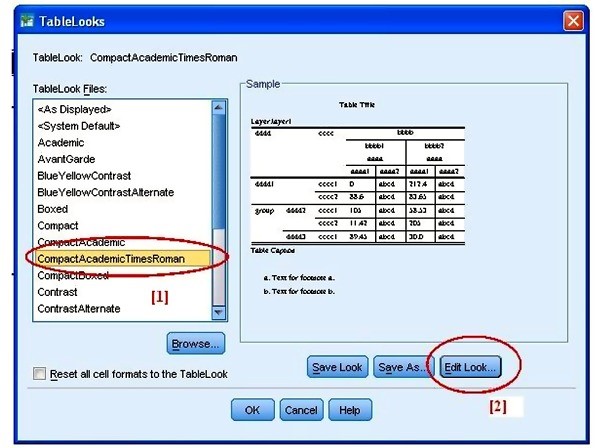
    • From the list of ‘TableLook’ files, select ‘CompactAcademicTimesRoman’
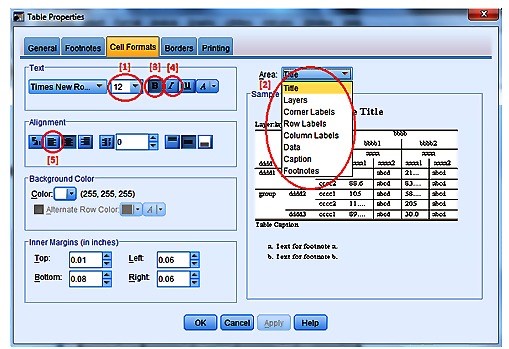
    • Hit Edit which will direct you to the “Table Properties” screen.
      fig9
    • Using the ‘Cell Formats’ tab, adjust the font to 12-point.
    • Adjusting the font separately for each element from a drop down menu is a must.
      fig10
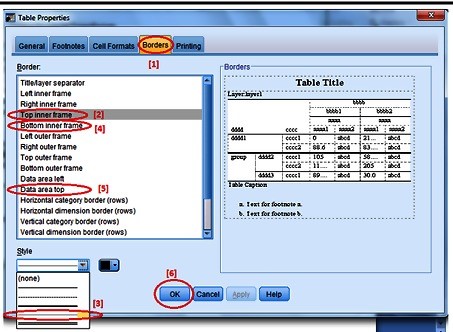
    • In the ‘Table Properties’ window, switch to the ‘Borders’ tab.
    • Keep holing down the ctrl key and select ‘Top Inner Frame’, ‘Bottom Inner Frame’ and ‘Data Area’, top in the border menu.
    • Select the line style and click ‘OK’

    Now coming back to the ‘TableLook’ window, click ‘Save As’ and then name the ‘Table’ and click ‘Save’

  3. Applying the TableLook:
    fig11

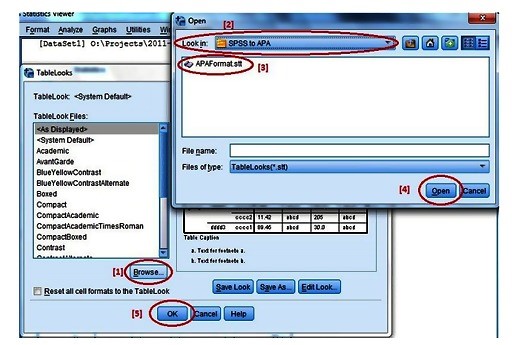
    • Coming back to the SPSS-Statistics Data Viewer, In the TableLook window, click on the ‘Browse’ button and use the look in bar to select the saved TableLook.
    • Click ‘Open’ and then hit ‘OK’ in the TableLook window.fig12
          1. And finally, you will get a table formatted in APA.
          1. Cheers to the SPSS, saved an extensive amount of time.
          1. For any query, reach us at

      info@statisticsconsultation.com